
Artificial Intelligence
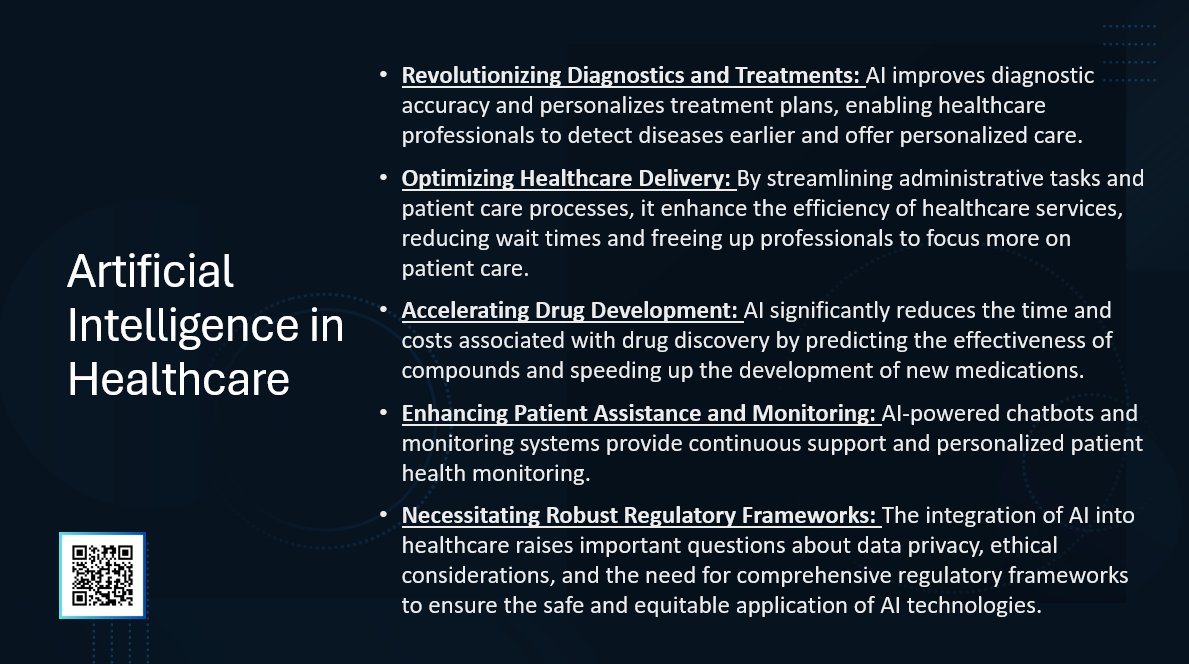
Artificial Intelligence (AI) in healthcare is revolutionizing medical diagnostics, treatment, and management by leveraging technologies like machine learning, natural language processing, and robotics. These AI systems excel in interpreting vast medical datasets, enhancing diagnostic accuracy, personalizing treatments, and optimizing healthcare delivery. They support administrative tasks, provide patient assistance through chatbots, and accelerate drug development, potentially transforming healthcare efficiency and patient outcomes. However, this rapid integration of AI in healthcare also necessitates careful attention to data privacy, ethical considerations, and the development of comprehensive regulatory frameworks to ensure its safe and equitable application.
Artificial Intelligence
Latest Posts
-
Collaboration between UCSF, Intel to develop deep learning analytics for healthcare
UC San Francisco’s Center for Digital Health Innovation (CDHI) today announced a collaboration with Intel Corporation to deploy and validate a deep learning analytics platform designed to improve care by helping clinicians make better treatment decisions, predict…
-
Researchers use multi-task deep neural networks to automatically extract data from cancer pathology reports
Despite steady progress in detection and treatment in recent decades, cancer remains the second leading cause of death in the United States, cutting short the lives of approximately 500,000 people each year. To better understand and combat…
-
Researchers identify suicidal behavior using machine learning algorithm on patients verbal and non-verbal data
A new study shows that machine learning is up to 93 percent accurate in correctly classifying a suicidal person and 85 percent accurate in identifying a person who is suicidal, has a mental illness but is not…
-
Novel diagnostic test for malaria using holographic imaging and artificial intelligence using deep learning
Duke researchers have devised a computerized method to autonomously and quickly diagnose malaria with clinically relevant accuracy — a crucial step to successfully treating the disease and halting its spread. In 2015 alone, malaria infected 214 million…
You must be logged in to post a comment.