
Artificial Intelligence
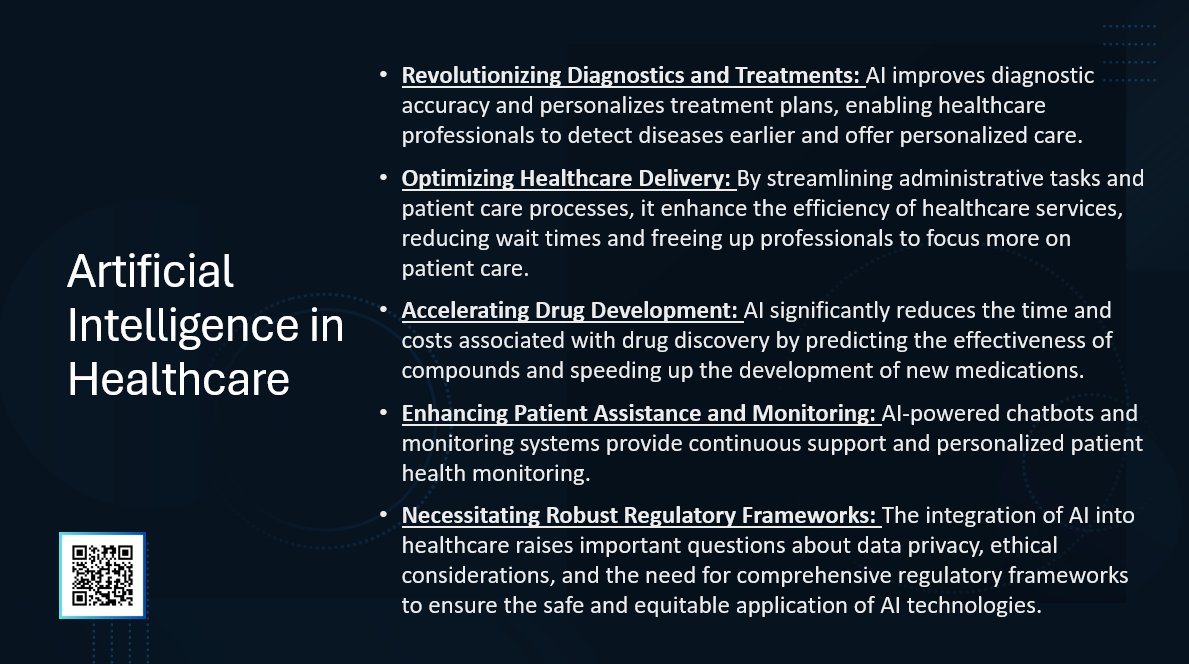
Artificial Intelligence (AI) in healthcare is revolutionizing medical diagnostics, treatment, and management by leveraging technologies like machine learning, natural language processing, and robotics. These AI systems excel in interpreting vast medical datasets, enhancing diagnostic accuracy, personalizing treatments, and optimizing healthcare delivery. They support administrative tasks, provide patient assistance through chatbots, and accelerate drug development, potentially transforming healthcare efficiency and patient outcomes. However, this rapid integration of AI in healthcare also necessitates careful attention to data privacy, ethical considerations, and the development of comprehensive regulatory frameworks to ensure its safe and equitable application.
Artificial Intelligence
Latest Posts
-
GPT-4 Excels in Japanese Medical Exam, Revealing AI’s Strengths and Limits in Medicine
In a study focusing on GPT-4’s clinical reasoning and medical knowledge, particularly in Japanese, researchers used the AI to answer exam questions from the General Medicine In-Training Examination (GM-ITE), comparing its performance with Japanese medical residents across…
-
Predicting Neurodevelopmental Outcomes in Preterm Infants: Insights from aEEG–EEG and Machine Learning
Researchers analyzed a cohort of preterm infants (born before 28 weeks of gestation) at the Wilhelmina Children’s Hospital in the Netherlands, focusing on predicting neurodevelopmental outcomes using early postnatal amplitude-integrated electroencephalogram (aEEG) and raw EEG features. The…
-
Revolutionizing Breast Cancer Prognosis with Novel Digital Biomarker Histomic Prognostic Signature(HiPS): A New AI-Driven Approach
The Northwestern Medicine study introduces a novel digital biomarker, the Histomic Prognostic Signature (HiPS), using a new deep learning-based AI tool designed to improve breast cancer prognosis. Traditional methods, like the Nottingham criteria used by pathologists, focus…
-
AI-Generated Health Disinformation: A Growing Threat to Public Health and the Urgent Need for Enhanced Vigilance and Regulation
While beneficial in modern medicine, artificial intelligence poses a significant risk of generating targeted health disinformation, threatening public health and safety. In a demonstration, researchers from Flinders University used a single large-language AI model to produce 102…
-
UltraSight AI Guidance
UltraSight AI Guidance uses machine learning and AI to provide real-time, dynamic guidance for medical practitioners using diagnostic ultrasound systems, with a focus on 2D-TTE for adult patients. This technology ensures accurate transducer positioning for high-quality heart…
-
Uncovering Ethnic Disparities in AI-Based Diagnosis of Bacterial Vaginosis: A University of Florida Study
Researchers from the University of Florida have discovered diagnostic biases in machine learning algorithms used for diagnosing bacterial vaginosis (BV). Nature’s Digital Medicine journal published this article. The study, led by Ruogu Fang and Ivana Parker, analyzed…
-
Using Epigenetic Factors UCLA Cancer Researchers Develop AI Model to Predict Patient Outcomes in Multiple Cancer Types
Researchers at UCLA’s Jonsson Comprehensive Cancer Center developed an AI model that predicts patient outcomes in various cancer types using epigenetic factors (epifactors). This model categorizes cancers into distinct groups based on the gene expression patterns of…
-
AI-Powered Abdominal CT Analysis Predicts Fall Risk
Researchers evaluate the potential of automated artificial intelligence (AI)-based body composition algorithms to predict future fall risks in patients. Their study used automated abdominal CT-based measures of muscle, fat, and bone to provide a novel method for…
-
AI Models Predicts Autism Behaviors with High Accuracy: Linking Sleep and GI Health to Behavioral Challenges
Researchers at Rensselaer Polytechnic Institute explore using AI models to predict challenging behaviors in individuals with Autism Spectrum Disorder (ASD). They found a link between sleep, gastrointestinal health, and challenging behaviors in individuals with profound autism. The…
-
AI/ML: Magentiq Eye Automatic Polyp Detection System (ME-APDS)
The Magentiq Eye’s Automatic Polyp Detection System (ME-APDS), also known as MAGENTIQ-COLO™, is a groundbreaking advancement in gastroenterology, utilizing AI to enhance the accuracy of colonoscopies. This innovative system processes video frames in real-time to assist endoscopists…
You must be logged in to post a comment.