
Artificial Intelligence
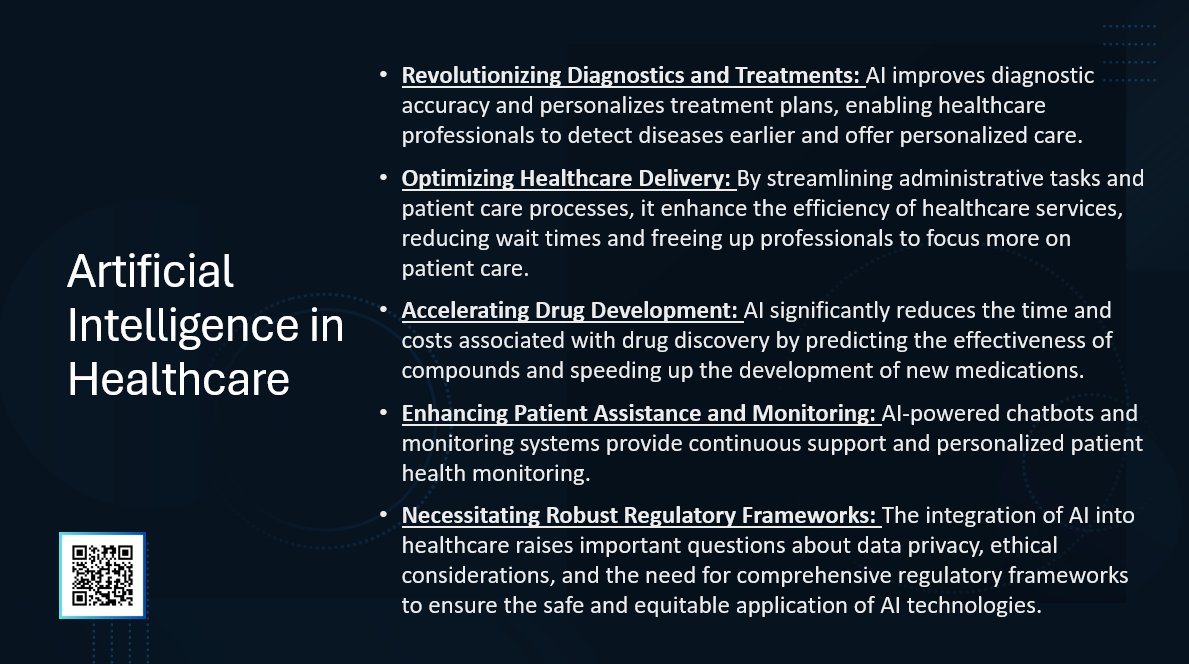
Artificial Intelligence (AI) in healthcare is revolutionizing medical diagnostics, treatment, and management by leveraging technologies like machine learning, natural language processing, and robotics. These AI systems excel in interpreting vast medical datasets, enhancing diagnostic accuracy, personalizing treatments, and optimizing healthcare delivery. They support administrative tasks, provide patient assistance through chatbots, and accelerate drug development, potentially transforming healthcare efficiency and patient outcomes. However, this rapid integration of AI in healthcare also necessitates careful attention to data privacy, ethical considerations, and the development of comprehensive regulatory frameworks to ensure its safe and equitable application.
Artificial Intelligence
Latest Posts
-
Revolutionizing Colonoscopy: AI Increases Polyp Detection
A landmark study from Radboud University Medical Center, published in The Lancet Digital Health, demonstrates how AI-assisted colonoscopies can detect 40% more polyps, significantly enhancing the early detection of colorectal cancer precursors. This breakthrough could transform colorectal…
-
FaMeSumm: Faithfulness For Medical Summarization Framework For Creating Accurate Medical Summaries Using AI
Researchers from Penn State have developed FaMeSumm, a novel AI framework to improve the accuracy and reliability of medical summarization in electronic health records and insurance processing. By addressing the “faithfulness issue” in existing summarization tools through…
-
BoneView: Enhancing Radiographic Fracture Detection with AI
BoneView 1.1-US by GLEAMER is a machine-learning software designed to aid clinicians in detecting fractures in radiographs, covering a wide range of anatomical areas for adults and children. It operates on various platforms and has demonstrated high…
-
SynergyX: Multi-Modality Mutual Attention Network for Drug Combination Prediction
SynergyX is a multi-modality mutual attention network that dramatically improves the prediction of anti-tumor drug synergies by leveraging intricate biological interactions and multi-omic data integration. This advanced approach outshines the accuracy of existing models, providing critical insights…
-
EyeArt: AI-based Diabetic Retinopathy Detection software
EyeArt v2.2.0, developed by Eyenuk Inc., is an AI-powered Class II medical device designed to automatically detect signs of diabetic retinopathy in adult diabetic patients using high-resolution retinal images. This innovative software aims to improve early detection…
-
DrugAI: A Generative AI Model To Streamline Drug Discovery
At Chapman University’s Schmid College of Science and Technology, scientists have unveiled “DrugAI,” a cutting-edge generative artificial intelligence model designed for de novo drug design. By utilizing a comprehensive dataset and advanced algorithms, DrugAI generates unique molecular…
-
Medicare Fraud Detection: A New Computational Approach
Medicare fraud, costing over $100 billion annually, overwhelms traditional detection methods. Florida Atlantic University’s novel study introduces advanced techniques using big data analytics and machine learning to improve fraud detection, highlighting the potential to reduce fraud-related costs…
-
COMPOSER AI Model By UC San Diego Reduces Sepsis Mortality
The COMPOSER AI model, analyzing over 150 patient variables, significantly decreased sepsis mortality by 17% in a UC San Diego Health study. It accurately predicted high-risk cases, leading to a 1.9% absolute reduction in mortality, 5% better…
-
IntelliGenes: AI-Driven Genomic Biomarker Analysis
Rutgers Health’s IntelliGenes software leverages AI and ML to evaluate genomic biomarkers for disease prediction. It combines multi-genomic data with an Intelligent Gene (I-Gene) score for precise trait predictions. Validated on the Amarel cluster, it accurately identified…
-
MOVER Dataset: Medical Informatics Operating Room Vitals and Events Repository
The Medical Informatics Operating Room Vitals and Events Repository (MOVER), a collaborative effort by UCLA and UC Irvine, merges electronic health records with physiological waveform data from over 83,000 surgeries. Aimed at utilizing AI for improving surgical…
You must be logged in to post a comment.