
Artificial Intelligence
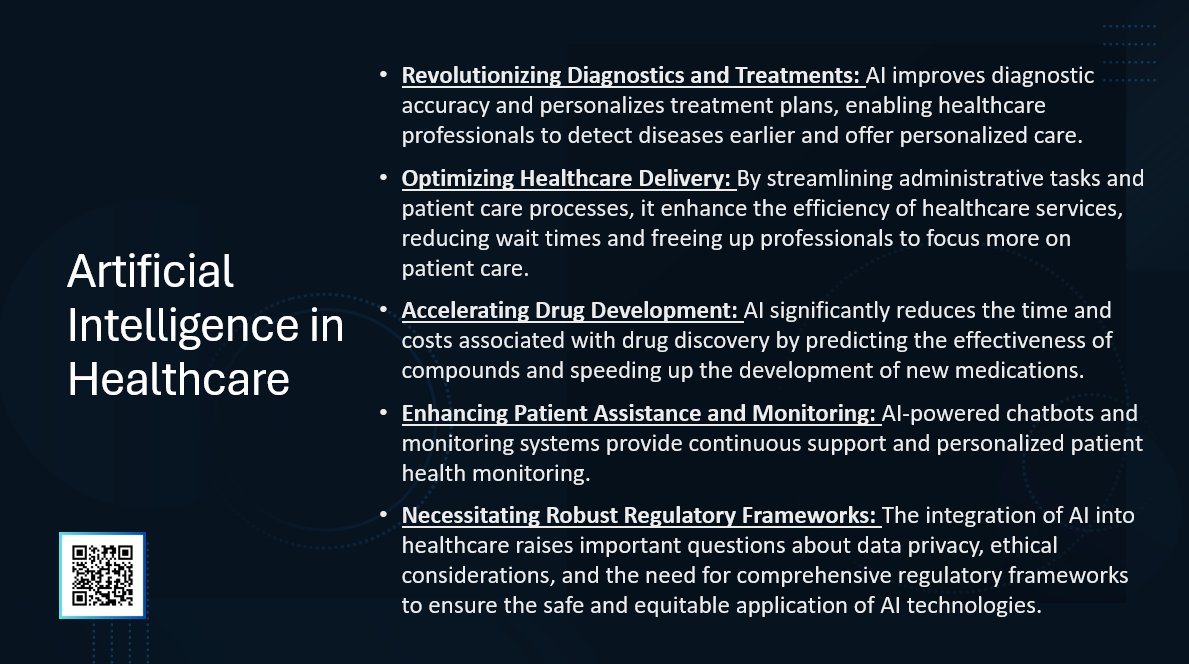
Artificial Intelligence (AI) in healthcare is revolutionizing medical diagnostics, treatment, and management by leveraging technologies like machine learning, natural language processing, and robotics. These AI systems excel in interpreting vast medical datasets, enhancing diagnostic accuracy, personalizing treatments, and optimizing healthcare delivery. They support administrative tasks, provide patient assistance through chatbots, and accelerate drug development, potentially transforming healthcare efficiency and patient outcomes. However, this rapid integration of AI in healthcare also necessitates careful attention to data privacy, ethical considerations, and the development of comprehensive regulatory frameworks to ensure its safe and equitable application.
Artificial Intelligence
Latest Posts
-
Deep Learning ECG Model for Right Ventricular Assessment
A study by the Icahn School of Medicine at Mount Sinai demonstrates deep learning–enabled electrocardiogram (ECG) analysis for accurately estimating right ventricular size and function, offering a simpler alternative to traditional imaging methods.
-
ICU Admission and Outcome Prediction Risk Score Model
Researchers from Regenstrief Institute and Indiana University School of Medicine have developed the Prediction Risk Score, a model based on electronic health records to predict ICU admissions and outcomes for older adults, potentially transforming critical care management.
-
AI’s Role in Enhancing Prehospital Decision-Making in Trauma Care
The research conducted by Chalmers University of Technology, the University of Gothenburg, and the University of Borås in Sweden highlights the potential of AI in assisting healthcare professionals with rapid, life-critical decisions in trauma care. This study…
-
Evaluating Large Language Models in Medicine: A Study on GPT-3.5 and GPT-4’s Accuracy in Answering Medical Questions
In a study exploring the use of Large Language Models (LLMs) like GPT-3.5 and GPT-4 for answering surgical questions from the MedMCQA dataset, GPT-3.5 and GPT-4 achieved accuracies of 53.3% and 64.4%, respectively, indicating significant differences in…
-
AI Predicts Long-Term Vision Outcomes in High Myopia Patients
Tokyo Medical and Dental University researchers created machine-learning models to forecast long-term visual outcomes in high myopia patients, analyzing 1616 eyes from 967 patients. Their findings, highlighting the models’ accuracy over 3 and 5 years, assist in…
-
Innovative AI Model by Scripps Research Institute Enhances Atrial Fibrillation Screening
Researchers at Scripps Research have developed an AI model that significantly advances atrial fibrillation (AFib) screening by detecting subtle variations in normal heartbeats, indicating the risk of AFib. This model, which analyzes atrial fibrillation-free ECG data and…
-
Virtual Reality Technology Aids Autistic Individuals in Public Transport Navigation
Researchers are utilizing virtual reality technology to train and assist autistic individuals in navigating public transportation. This Artificial intelligence powered research found that autistic individuals process sensory information differently, affecting their environmental perception. This insight can help…
-
AI Tools For Research Paper Analysis
In today’s digital age, various innovative AI tools are revolutionizing how we conduct research, manage information, and process large volumes of text. These AI tools, designed to streamline various aspects of research analysis include:
-
Advancements in Breast Cancer Detection: AI-Based Risk Model Proves Effective in European Study
An international study led by Karolinska Institutet in Sweden, published in The Lancet Regional Health – Europe, demonstrates the effectiveness of an AI-based risk model in identifying women at high risk of breast cancer during mammography screenings.…
You must be logged in to post a comment.