
Artificial Intelligence
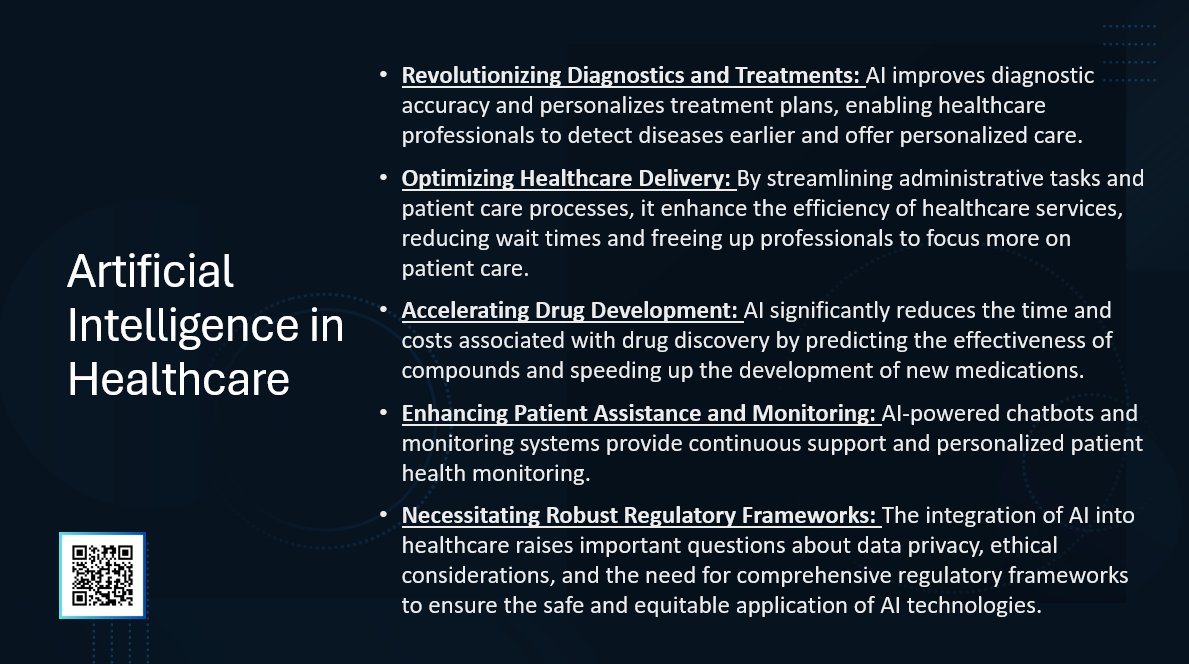
Artificial Intelligence (AI) in healthcare is revolutionizing medical diagnostics, treatment, and management by leveraging technologies like machine learning, natural language processing, and robotics. These AI systems excel in interpreting vast medical datasets, enhancing diagnostic accuracy, personalizing treatments, and optimizing healthcare delivery. They support administrative tasks, provide patient assistance through chatbots, and accelerate drug development, potentially transforming healthcare efficiency and patient outcomes. However, this rapid integration of AI in healthcare also necessitates careful attention to data privacy, ethical considerations, and the development of comprehensive regulatory frameworks to ensure its safe and equitable application.
Artificial Intelligence
Latest Posts
-
Deep Neural Network Predicts Biological Age Through Hormone Analysis
Key Points AI Blood Test for Aging – Uses hormone levels to predict biological age accurately. Stress Speeds Up Aging – High cortisol levels can increase biological age by 1.5 times. Personalized Health Plans – Helps create…
-
AI-Powered Blood Test Enables Early Breast Cancer Detection
Key Points An AI-powered blood test detects and classifies breast cancer at stage 1a. Integrates Raman spectroscopy and machine learning for non-invasive diagnosis. Promises enhanced early detection and personalized cancer treatment. Introduction Researchers at the University of…
-
Bladder AI
Bladder AI is a standalone software application designed to aid healthcare professionals in evaluating bladder ultrasound images. It uses machine learning to simplify workflow and improve accuracy. Developed by Exo Imaging and cleared by the FDA, it’s…
-
Brainlab Elements Suite
The Brainlab Elements suite, version 6.0, comprises a range of software applications tailored for image-guided surgery and radiation treatment planning, including modules like Contouring, Image Fusion, and Fibertracking. These applications are designed to aid medical professionals by…
-
HLA Inception: A Convolutional Neural Network To Predict MHC-I Peptide Bindings
Arizona State University scientists developed “HLA Inception,” a groundbreaking AI tool using convolutional neural networks to predict MHC-1 peptide bindings. This tool, leveraging molecular electrostatics, offers rapid, proteome-scale predictions, transforming complex analysis processes from days to seconds…
-
Flexible Paper-Based Sensor: A Leap Towards Sustainable AI in Health Monitoring
Researchers at Tokyo University of Science have developed a novel, eco-friendly paper-based sensor that mimics the human brain’s neural network, offering a sustainable alternative for health monitoring. This sensor not only addresses the environmental costs associated with…
-
AI Powered Enhanced Feedback for Surgical Training
An innovative AI program developed by researchers from the Ying Wu College of Computing at the New Jersey Institute of Technology and collaborators transforms surgical education by providing real-time, automated feedback to students practicing laparoscopic surgery. Utilizing…
-
MoodCapture AI App: A New Frontier in Depression Monitoring
Researchers at Dartmouth have developed MoodCapture. This innovative AI-powered smartphone app analyzes facial expressions and environmental factors to proactively detect signs of depression with a 75% success rate, as demonstrated in a 90-day study involving 177 participants.…
-
A-SOiD: Open-Source AI for Diverse Behavioral Prediction
Researchers have unveiled A-SOiD, a novel open-source active-learning platform capable of understanding and forecasting a wide array of behaviors from animal interactions to human activities and even complex patterns like stock market movements and earthquakes. Published in…
You must be logged in to post a comment.